Introduction
Recruiters are the people who find and hire talent for companies. Most work in one of four settings: staffing agencies, in-house talent teams, executive search firms or outsourced hiring (RPO) teams. They buy tools for every step of hiring, and they reply to short messages that match what they’re measured on.
If you sell HR software, job ads, skills tests or background checks, recruiters are one of the best audiences you can target. They spend money all year, and they move quickly when a tool saves them time. The catch is that a pitch built for an agency recruiter can fall flat with an in-house team. This infographic shows you how to tell them apart and what to say to each one.
How big is the recruiter market?
Bigger than most people expect. The US Bureau of Labor Statistics counts about 939,700 human resources specialist jobs, and it lists recruiters as one of the main types within that group. It also expects these jobs to grow by 6% over the next decade, about twice the average for all jobs.
The staffing side is just as busy. According to the American Staffing Association, US staffing firms hired 9.5 million temporary and contract workers in 2025, with nearly 2 million on the job in an average week. In its most recent count (2021), the association found around 27,000 staffing and recruiting companies running close to 54,000 offices across the country. Every one of those offices needs tools, data, and services to keep hiring moving.
Who are recruiters? The four main types
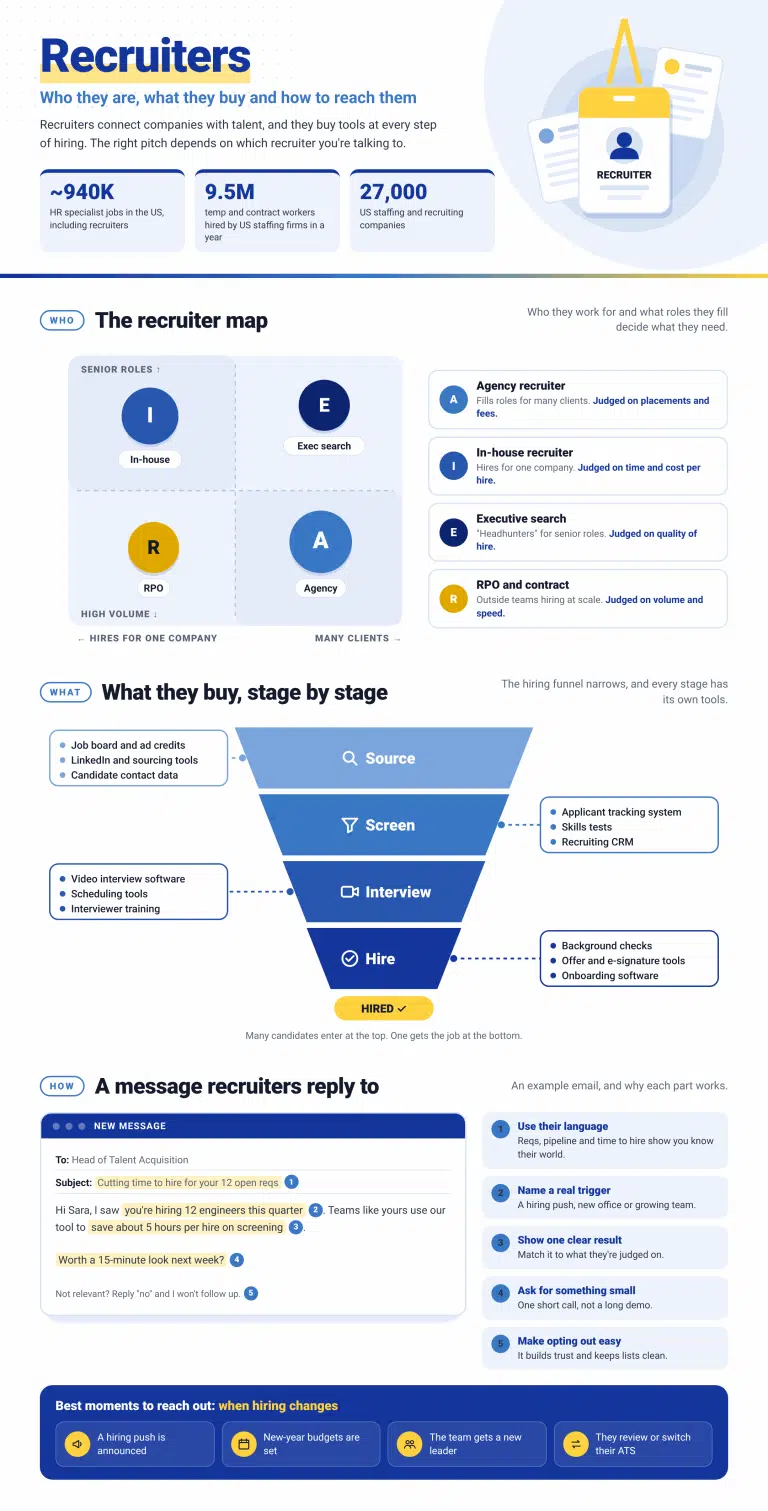
The recruiter map in the infographic sorts recruiters by two simple questions. Do they hire for one company or for many clients? And do they fill lots of everyday roles or a few senior ones? The answers tell you a lot about what each type needs.
Agency recruiters
Agency recruiters work for staffing or recruiting firms and fill roles for many client companies at once. They usually earn a fee when a candidate is placed, so speed matters. They’re judged on placements and fees, and they like anything that helps them submit strong candidates before a rival agency does.
In-house recruiters
In-house recruiters work inside one company’s HR or talent acquisition team. They hire only for their own employer and work closely with hiring managers. Their scorecard is time to hire and cost per hire, so tools that remove busywork or cut agency fees get their attention.
Executive search recruiters
Often called headhunters, executive search recruiters find senior leaders such as directors, vice presidents, and C-level executives. They run fewer searches, but each one carries high stakes and needs discretion. They’re judged on the quality and fit of the people they place, not on volume.
RPO and contract recruiters
RPO stands for recruitment process outsourcing. A company hands part or all of its hiring to an outside team that works as an extension of its HR department. Contract recruiters do something similar for a set period. Both are usually brought in to hire a lot of people quickly, so they’re judged on volume and speed.
What do recruiters buy?
Think of hiring as a funnel. Many candidates enter at the top, and one person gets the job at the bottom. Recruiters buy different tools at each stage:
- Source: job boards and ad credits, LinkedIn and other sourcing tools, and candidate contact data to reach people who aren’t applying yet.
- Screen: an applicant tracking system (ATS) to manage every application, skills tests to check ability, and a recruiting CRM to stay in touch with past candidates.
- Interview: video interview software, scheduling tools that end the back-and-forth over email, and training for hiring managers who run interviews.
- Hire: background and reference checks, offer and e-signature tools, and onboarding software for the new hire’s first weeks.
The ATS sits at the center of it all. Most other tools need to connect to it, so it’s smart to find out which applicant tracking system a recruiting team uses before you pitch. If your product works with their system, say so early.
How do you write a message recruiters reply to?
Recruiters spend their whole day sending and reading messages, so they can spot a generic pitch in seconds. The infographic shows an example email that works. Here’s what it looks like:
Subject: Cutting time to hire for your 12 open reqs
Hi Sara, I saw you’re hiring 12 engineers this quarter. Teams like yours use our tool to save about 5 hours per hire on screening. Worth a 15-minute look next week?
Not relevant? Reply “no” and I won’t follow up.
This is an example only, so swap in your own details and real results. Each part of it does a specific job:
- Use their language. Words like “reqs” (open job requisitions), “pipeline,” and “time to hire” show you understand their work.
- Name a real trigger. Mention something true and recent, such as a hiring push, a new office, or a growing team.
- Show one clear result. Pick the result that matches what they’re judged on. Time saved suits in-house teams, while more placements suit agencies.
- Ask for something small. A short call is an easy yes. A long demo is an easy no.
- Make opting out easy. It builds trust, respects their time, and keeps your contact list clean.
When is the best time to reach recruiters?
The best time is when their hiring changes. These four moments usually mean new needs and fresh budget:
- A hiring push is announced. More open roles mean more pressure to work faster.
- New-year budgets are set. Teams decide which tools to keep, drop, or add.
- The team gets a new leader. A new head of talent, such as a chief human resources officer, often reviews the whole tool stack.
- They review or switch their ATS. A new core system opens the door to new tools that connect with it.
Frequently asked questions
What is the difference between an agency recruiter and an in-house recruiter?
An agency recruiter works for a staffing or recruiting firm and fills roles for many client companies, usually for a fee. An in-house recruiter works for one company and hires only for that employer. Agency recruiters focus on placements, while in-house recruiters focus on time to hire and cost per hire.
What does RPO mean in recruiting?
RPO stands for recruitment process outsourcing. A company hands part or all of its hiring to an outside team, which acts like an extension of the company’s HR department. Companies often use RPO when they need to hire many people quickly.
What software do recruiters use most?
The applicant tracking system (ATS) is the main tool for most recruiting teams. It stores applications, tracks each candidate’s progress, and connects to other tools such as job boards, assessments, and scheduling software.
What is a recruiting funnel?
A recruiting funnel shows how many candidates move through each hiring stage. It usually runs from sourcing to screening, interviewing, and hiring. Many people enter at the top, and the group gets smaller at each stage until one person is hired.
How do you get a recruiter to reply to a cold email?
Keep it short and specific. Mention a real reason you’re reaching out, show one result that matches their goals, and ask for a small next step, like a 15-minute call. Always give them an easy way to opt out.